7 Insightful: What Questions Does a Marriage Counsellor Ask?
Marriage counselling often begins with questions that help a couple understand what is happening in their relationship. If you are wondering what questions does a marriage counsellor ask, it is helpful to know that the questions are generally designed to understand communication patterns, emotional concerns, conflicts, expectations, and relationship goals. Couples in Kalamassery may also seek counselling when they feel stuck in repeated arguments or find it difficult to discuss important issues calmly.
A marriage counsellor does not simply ask questions to find out who is right or wrong. Instead, the questions can help both partners express their experiences and understand each other more clearly. The discussion is usually guided in a supportive and structured way.
Knowing what questions does a marriage counsellor ask can also make the first counselling session feel less uncertain. While every couple’s situation is different, several common areas are explored during marriage counselling.
1. What Questions Does a Marriage Counsellor Ask During the First Session?
The first session usually focuses on understanding the couple’s relationship and the reasons they decided to seek professional support.
A counsellor may ask questions such as:
- What brought you to counselling?
- How long have you been experiencing difficulties?
- What concerns you most about the relationship?
- When did you first notice these problems?
- What would you like to change?
- Have you tried anything to resolve the issue?
- What do you hope to achieve through counselling?
These questions help establish the background of the relationship. They can also help the counsellor understand whether the main concern involves communication, trust, emotional distance, recurring arguments, intimacy, family pressure, or another relationship issue.
The first session is not necessarily about solving every problem immediately. It is often about creating a clear picture of the couple’s current situation.
2. Questions About Communication
Communication is one of the most important areas explored in marriage counselling. Couples may love each other but still struggle to communicate their needs effectively.
A counsellor may ask:
- How do you usually communicate when something is bothering you?
- What happens when you disagree?
- Do you feel heard by your partner?
- Do conversations often turn into arguments?
- How do you usually end an argument?
- Do either of you avoid difficult conversations?
- Can you express your feelings comfortably?
These questions can reveal communication patterns that couples may not notice on their own.
For example, one partner may become quiet during conflict while the other continues asking questions. This can create a cycle where one person feels ignored and the other feels pressured. Identifying such patterns is an important part of relationship counselling.
The goal is not simply to talk more. It is to develop healthier communication, active listening, emotional awareness, and constructive problem-solving.
3. Questions About Relationship Conflicts
When couples repeatedly experience the same arguments, a marriage counsellor may explore the nature of those conflicts.
Common questions include:
- What do you argue about most often?
- How frequently do disagreements occur?
- What usually starts an argument?
- What happens after an argument?
- Are there unresolved issues from the past?
- Do you feel that the same problem keeps returning?
- How do you normally try to resolve disagreements?
The counsellor may pay attention not only to the topic of the argument but also to how the couple interacts during conflict.
For instance, the disagreement may appear to be about finances, household responsibilities, or parenting. However, the underlying concern could involve feeling unappreciated, unsupported, unheard, or disconnected.
Understanding the underlying emotional concerns can help couples move beyond repeatedly discussing the same surface-level issue.
4. Questions About Emotional Connection
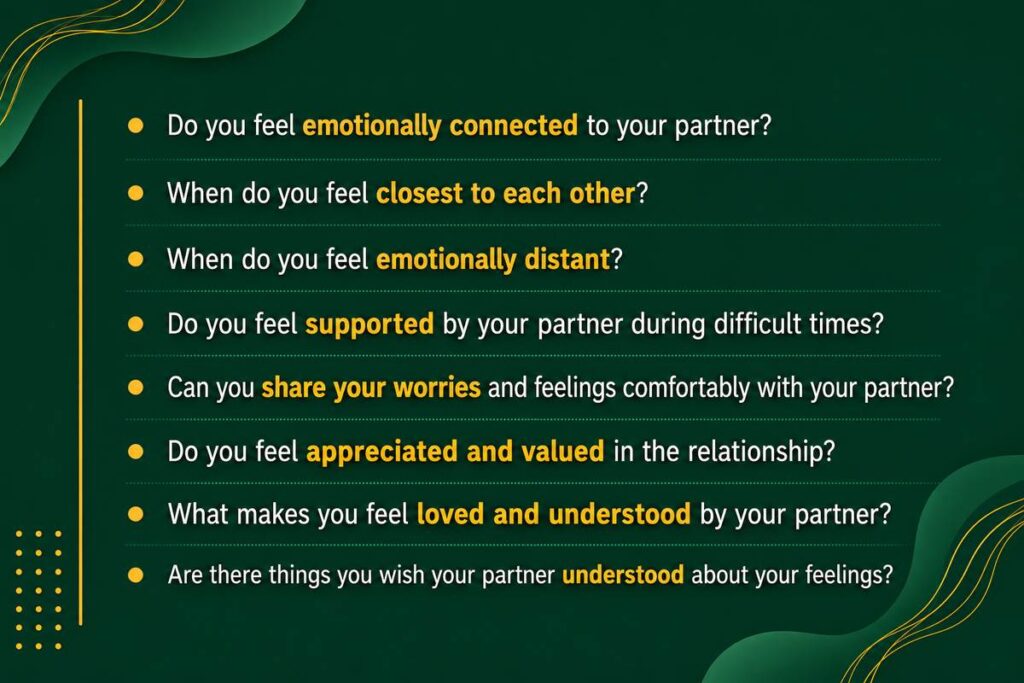
Emotional connection can change over time, particularly when couples are dealing with work pressure, parenting responsibilities, financial concerns, or other life changes.
A counsellor may ask:
- Do you feel emotionally connected to your partner?
- When do you feel closest to each other?
- When do you feel emotionally distant?
- Do you feel supported during difficult situations?
- Can you share your worries with your partner?
- Do you feel appreciated?
- What makes you feel loved and valued?
These questions can help identify emotional needs within the relationship.
Sometimes a couple may spend considerable time together but still feel emotionally disconnected. Other couples may communicate regularly but struggle to discuss vulnerable feelings.
Marriage counselling can provide a structured environment where these concerns can be discussed without immediately turning into an argument.
5. Questions About Trust and Relationship Security
Trust can become an important topic when a relationship has experienced dishonesty, secrecy, broken promises, emotional distance, or other difficult experiences.
Questions may include:
- Do you feel you can trust your partner?
- Has anything affected your trust in the relationship?
- Are there unresolved trust concerns?
- Do you feel emotionally secure with your partner?
- What would help rebuild trust?
- Do you feel your partner is honest with you?
These questions are not necessarily intended to place blame. Instead, they can help identify what has damaged trust and what both partners may need to feel secure again.
Rebuilding trust can take time. Open communication, consistency, accountability, and realistic expectations may all play a role.
6. Questions About Expectations and Relationship Needs
Every person enters a marriage with certain expectations. Problems may arise when partners have different ideas about responsibilities, affection, communication, finances, family involvement, or personal space.
A counsellor may ask:
- What do you expect from your partner?
- Do you feel your needs are being understood?
- What responsibilities do you believe should be shared?
- How do you show affection?
- How do you prefer to receive affection?
- Do you have enough personal space?
- What changes would make the relationship better?
These questions can help couples understand that different expectations do not necessarily mean that a relationship cannot work.
The important step is learning how to communicate expectations clearly and negotiate differences respectfully.
7. Questions About Family, Finances and Daily Responsibilities
Marriage counselling may also address practical issues that create relationship stress.
A counsellor may ask about:
- Household responsibilities
- Parenting responsibilities
- Financial decision-making
- Work-life balance
- Extended family involvement
- Personal time
- Major lifestyle decisions
For example, one partner may feel they are handling most household responsibilities while the other believes responsibilities are already balanced. Discussing these perceptions openly can help identify areas where expectations differ.
Financial concerns can also affect emotional well-being within a marriage. Questions about spending, saving, financial priorities, and decision-making may become relevant when money is a major source of conflict.
8. Questions About Intimacy and Affection
Depending on the couple’s concerns and comfort level, a marriage counsellor may ask questions about emotional and physical intimacy.
These questions may include:
- Do you feel emotionally close to your partner?
- Has affection changed over time?
- Are you satisfied with the level of intimacy?
- Do you feel comfortable discussing intimate concerns?
- Are there differences in expectations about intimacy?
- Have stress or relationship conflicts affected closeness?
Such discussions should be approached respectfully and without judgment.
Intimacy is not limited to physical affection. Emotional closeness, trust, affection, companionship, and feeling understood can all influence how connected partners feel.
9. Questions About Past Relationship Experiences
Past experiences can sometimes influence present relationship patterns.
A counsellor may ask:
- Have you experienced similar relationship problems before?
- What did relationships teach you about communication?
- Are there past experiences affecting your current relationship?
- Have previous conflicts remained unresolved?
- Do you notice any repeated patterns?
The purpose is not to unnecessarily focus on the past. Instead, understanding relevant experiences may help explain current reactions or expectations.
For example, someone who has previously experienced betrayal may have difficulty trusting a partner even when there is no current evidence of dishonesty. Recognizing this pattern can create an opportunity for healthier communication.
10. Questions About Individual Feelings and Concerns
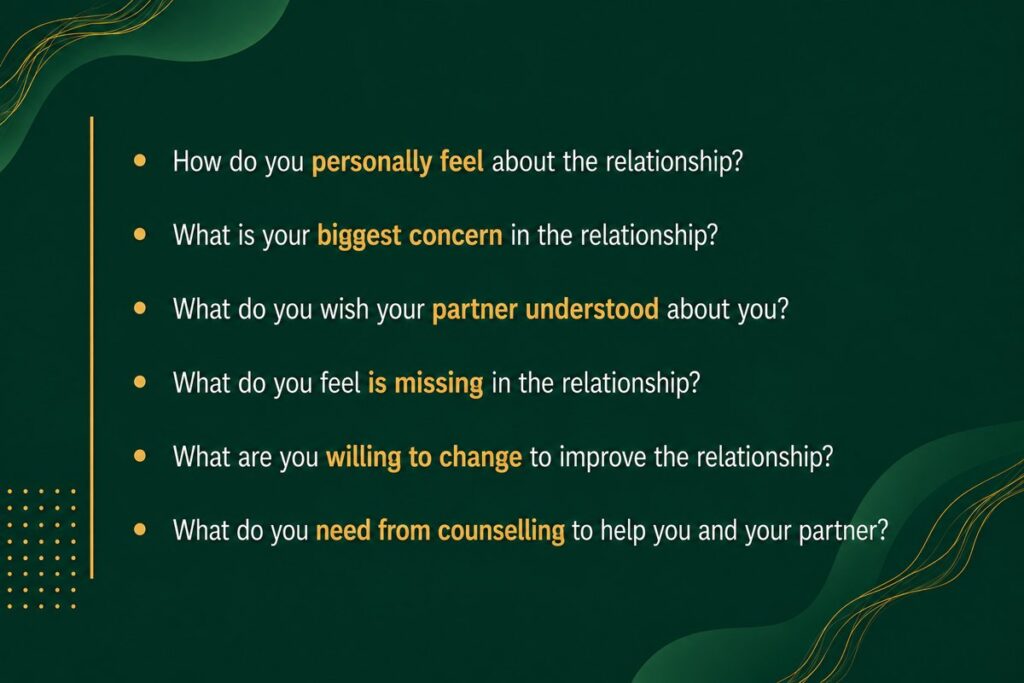
Marriage counselling focuses on the relationship, but each person’s individual experience also matters.
A counsellor may ask:
- How do you personally feel about the relationship?
- What is your biggest concern?
- What do you wish your partner understood about you?
- What do you feel is missing?
- What are you willing to change?
- What do you need from counselling?
These questions can encourage each partner to reflect on their own feelings instead of focusing exclusively on what the other person should change.
A balanced approach can help couples recognize that relationship improvement may involve changes from both sides.
11. Questions About What Each Partner Wants to Change
A counsellor may ask each person to identify specific changes they would like to see.
Examples include:
- What would you like your partner to do differently?
- What would you like to do differently yourself?
- What would make communication easier?
- What would help you feel more connected?
- What small change could improve the relationship?
Specific answers are often more useful than general statements.
For example, saying “I want better communication” is a starting point. Identifying a practical change such as “I want us to discuss important decisions without interrupting each other” provides a clearer direction.
12. Questions About Relationship Goals
Counselling becomes more meaningful when couples have a clear idea of what they want to accomplish.
A counsellor may ask:
- What would a healthier relationship look like for you?
- What would you like to improve first?
- What does a successful counselling process mean to you?
- What changes would make you feel that counselling is helping?
- What kind of relationship do you want in the future?
Goals may vary from couple to couple.
Some couples want to improve communication. Others want to rebuild trust, reduce conflict, strengthen emotional connection, or learn better ways to handle disagreements.
Having clear goals can make counselling sessions more focused.
13. Why Are These Questions Important?
Understanding what questions does a marriage counsellor ask can make counselling feel more approachable.
Questions provide the counsellor with information about:
- Relationship history
- Communication habits
- Conflict patterns
- Emotional needs
- Trust concerns
- Individual expectations
- Family responsibilities
- Intimacy concerns
- Relationship goals
They also encourage couples to slow down and think about problems from a different perspective.
A question that seems simple may reveal an important relationship pattern. For example, asking “What happens when you disagree?” may uncover avoidance, criticism, withdrawal, repeated arguments, or difficulty expressing emotions.
14. How Should You Prepare for Marriage Counselling?
You do not need to prepare perfect answers before attending counselling.
However, some simple preparation can make the session more productive.
Think About Your Main Concern
Consider the main reason you want counselling. Try to identify the problem that affects you most.
Be Honest
Honest communication allows the counsellor to understand the situation more accurately. You do not need to make the relationship appear perfect.
Avoid Preparing a List of Blame
It can be useful to describe what you experience rather than focusing only on what your partner does wrong.
Instead of saying, “My partner never listens,” you might explain what happens during conversations and how it makes you feel.
Think About Your Goals
Consider what you would like to improve. Your goal could be better communication, fewer arguments, stronger trust, or greater emotional connection.
Give Yourself Time
Some relationship concerns cannot be explained or resolved in a single session. Counselling can be a gradual process.
15. What Should You Expect During a Counselling Session?
A typical session may involve discussion, questions, reflection, and guided communication between partners.
The counsellor may listen to both perspectives and identify recurring interaction patterns.
Depending on the situation, couples may discuss:
- A recent disagreement
- A long-standing relationship concern
- Communication difficulties
- Emotional needs
- Trust
- Expectations
- Relationship goals
The counsellor may also encourage couples to practice different communication techniques.
The exact approach can vary depending on the counselling method, the couple’s concerns, and the stage of therapy.
16. Can You Ask the Counsellor Questions Too?
Absolutely. Counselling is not a one-way interview.
Couples can ask questions about the counselling process, such as:
- How does marriage counselling work?
- How often should we attend?
- What can we expect from sessions?
- How can we work on communication between sessions?
- What should we do when an argument occurs at home?
- How will our progress be evaluated?
Asking questions can help both partners understand the process and participate more actively.
17. Benefits of Understanding the Questions in Advance
Knowing what questions does a marriage counsellor ask can offer several practical benefits.
Reduces First-Session Anxiety
Knowing what to expect can make the first appointment feel less intimidating.
Encourages Honest Reflection
Thinking about relationship concerns beforehand may help you identify what you actually want to discuss.
Improves Communication
Understanding common counselling questions can encourage partners to discuss their feelings more clearly.
Helps Identify Patterns
Questions can bring attention to repeated arguments, emotional responses, or communication habits.
Supports Clearer Goals
Couples may enter counselling with a better understanding of the changes they would like to make.
Conclusion
Knowing what questions does a marriage counsellor ask can help couples approach counselling with greater confidence and realistic expectations. Questions about communication, conflict, trust, emotional connection, intimacy, expectations, responsibilities, and future goals can help identify the issues affecting a relationship.
Marriage counselling is not simply about answering questions. It is about creating a structured opportunity for both partners to understand their experiences, communicate more effectively, and work toward practical relationship goals. Couples seeking support in Kalamassery can consider professional marriage counselling when relationship concerns become difficult to manage independently. For additional information on relationships and mental health, visit the American Psychological Association (APA) for evidence-based resources on healthy relationships and relationship concerns.