7 Proven Benefits of Couples Therapy for Stronger Love Bonds
Relationships naturally go through periods of closeness, disagreement, change, and uncertainty. Couples therapy can help partners understand each other better, communicate more effectively, and work through relationship challenges in a structured and supportive setting. For couples in Kalamassery professional relationship support can provide a practical way to address concerns before they become more difficult to manage.
The benefits of couples therapy are not limited to relationships experiencing serious conflict. Couples may also seek therapy to strengthen an already healthy relationship, prepare for marriage, adjust to major life changes, or develop better ways of handling disagreements.
Couples therapy focuses on the relationship as a whole. Rather than simply deciding who is right or wrong, it helps partners identify patterns, understand emotional needs, improve communication, and develop healthier ways to respond to one another.
What Is Couples Therapy
Couples therapy is a form of counseling designed to help partners address emotional, communication, behavioral, and relationship concerns. It may be useful for married couples, engaged couples, long-term partners, or couples experiencing difficulties in their relationship.
During therapy sessions, partners can discuss concerns in a structured environment. A trained mental health professional helps the couple understand recurring patterns and develop healthier strategies for dealing with them.
Depending on the couple’s needs, therapy may focus on:
- Communication difficulties
- Frequent arguments
- Emotional disconnection
- Trust concerns
- Intimacy and affection
- Differences in expectations
- Family-related stress
- Financial disagreements
- Major life transitions
- Repeated relationship conflicts
The specific approach depends on the relationship and the concerns being addressed.
Why Do Couples Seek Therapy
There is no single reason why couples begin therapy. Some couples seek support after a major disagreement, while others recognize that their relationship has gradually become distant.
Common reasons include:
- Difficulty expressing feelings
- Repeated arguments about the same issues
- Feeling unheard or misunderstood
- Loss of emotional connection
- Problems rebuilding trust
- Differences in parenting approaches
- Stress related to work or finances
- Changes in intimacy
- Major family changes
- Difficulty resolving disagreements
- Uncertainty about the future of the relationship
Seeking therapy does not necessarily mean that a relationship is failing. In many situations, it simply means that both partners want to understand the relationship better and make constructive changes.
Benefits of Couples Therapy Include Better Communication
One of the most important benefits of couples therapy is improved communication.
Many relationship problems are not caused only by differences of opinion. They can develop because partners struggle to express what they actually need or because conversations quickly become defensive.
For example, one partner may say, “You never listen to me,” while the other responds defensively. The original concern can then become an argument rather than an opportunity for understanding.
Couples therapy can help partners learn to:
- Express concerns more clearly
- Listen without immediately becoming defensive
- Identify the feelings behind disagreements
- Ask questions instead of making assumptions
- Communicate needs respectfully
- Avoid harmful communication patterns
Better communication does not mean that couples will stop disagreeing. Instead, it can help them handle disagreements in a more productive way.
Couples Therapy Can Strengthen Emotional Connection
Emotional closeness can change over time. Busy schedules, work responsibilities, parenting, financial concerns, and other pressures can gradually reduce meaningful interaction between partners.
A couple may still live together and manage daily responsibilities while feeling emotionally distant.
Another major benefit of couples therapy is that it can help partners recognize this emotional distance and understand what may be contributing to it.
Therapy can encourage couples to explore:
- Emotional needs
- Feelings of loneliness
- Unmet expectations
- Affection and appreciation
- Shared experiences
- Emotional support
- Relationship priorities
Understanding each other’s emotional needs can create opportunities for greater empathy and connection.
Benefits of Couples Therapy Include Healthier Conflict Resolution
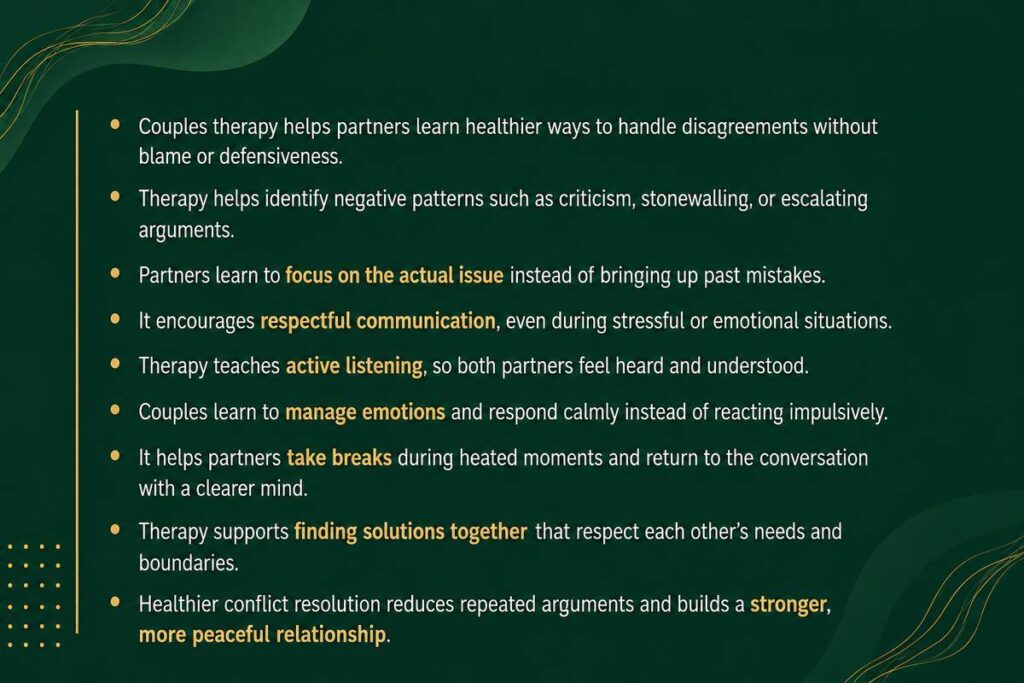
Disagreements are a normal part of relationships. The important issue is how couples respond when disagreements occur.
Some couples avoid difficult conversations completely. Others may argue repeatedly without reaching a meaningful resolution. In some relationships, minor disagreements can quickly become larger conflicts because of unresolved issues from the past.
One of the practical benefits of couples therapy is learning healthier conflict-resolution strategies.
Therapy may help partners:
- Identify the actual issue
- Stay focused on the current disagreement
- Avoid personal attacks
- Recognize escalation patterns
- Take appropriate breaks from heated conversations
- Listen to the other person’s perspective
- Work toward mutually acceptable solutions
Healthy conflict resolution does not require partners to agree on everything. It involves finding ways to disagree without damaging the relationship.
Couples Therapy Can Help Rebuild Trust
Trust is an important part of a stable relationship. When trust has been damaged, rebuilding it may require time, consistency, openness, and accountability.
Trust problems can arise from different circumstances, including dishonesty, broken promises, secrecy, or other behaviors that affect a partner’s sense of security.
Couples therapy can provide a structured environment for discussing these concerns.
The process may involve:
- Understanding what happened
- Allowing both partners to express their perspectives
- Recognizing emotional impact
- Discussing boundaries
- Establishing realistic expectations
- Developing consistent behaviors
- Rebuilding a sense of emotional safety
Therapy cannot guarantee that trust will be restored. However, it can help couples understand the underlying issues and determine what steps may be appropriate for moving forward.
Couples Therapy Can Improve Emotional Understanding
Partners may sometimes interpret the same situation very differently.
One person may view silence as giving space, while the other may experience it as emotional withdrawal. One partner may see repeated questions as concern, while the other experiences them as pressure.
These differences can create misunderstandings.
An important benefit of couples therapy is helping partners understand how each person experiences the relationship.
This may involve exploring:
- Emotional reactions
- Relationship expectations
- Personal boundaries
- Attachment patterns
- Communication styles
- Past experiences that influence current reactions
Greater understanding can make it easier for partners to respond thoughtfully rather than automatically reacting to each other’s behavior.
Benefits of Couples Therapy May Include Better Intimacy
Intimacy involves more than physical closeness. Emotional safety, affection, communication, trust, and mutual understanding can all influence intimacy within a relationship.
Stress and unresolved conflict may affect a couple’s emotional and physical connection.
Couples therapy can provide a space to discuss intimacy-related concerns respectfully and without unnecessary blame.
Depending on the situation, discussions may involve:
- Emotional closeness
- Affection
- Communication about needs
- Relationship expectations
- Changes in intimacy
- Feelings of rejection
- Stress and fatigue
- Trust and emotional safety
The goal is generally to improve mutual understanding and create healthier communication around sensitive subjects.
Couples Therapy Can Support Long-Term Relationship Growth
Perhaps one of the most valuable benefits of couples therapy is that it can help partners develop skills they can continue using after therapy ends.
A healthy relationship requires ongoing communication and adaptation. Couples may encounter new challenges as their circumstances change.
These may include:
- Marriage
- Parenthood
- Career changes
- Relocation
- Financial pressure
- Caring for family members
- Changes in health or lifestyle
- Children becoming independent
- Retirement
- Other major life transitions
Therapy can help couples develop a stronger foundation for navigating these changes together.
Rather than focusing only on one current disagreement, couples may learn strategies that can be applied to future relationship challenges.
What Happens During Couples Therapy
The exact structure of therapy varies depending on the couple’s concerns and the professional’s approach.
An initial session may involve discussing the relationship history, current concerns, communication patterns, and goals for therapy.
Later sessions may focus on specific relationship patterns and practical strategies.
A typical process may include:
Identifying Relationship Concerns
The couple discusses the issues that brought them to therapy and explains how these problems affect the relationship.
Understanding Communication Patterns
The therapist may help identify recurring interaction patterns, such as criticism, withdrawal, defensiveness, or avoidance.
Exploring Emotional Needs
Partners may discuss what they need to feel understood, supported, respected, and emotionally connected.
Developing Practical Strategies
The couple may learn communication and conflict-management techniques that can be practiced between sessions.
Reviewing Progress
Progress can be discussed periodically to determine which strategies are helping and which areas still need attention.
Different Types of Couples Therapy
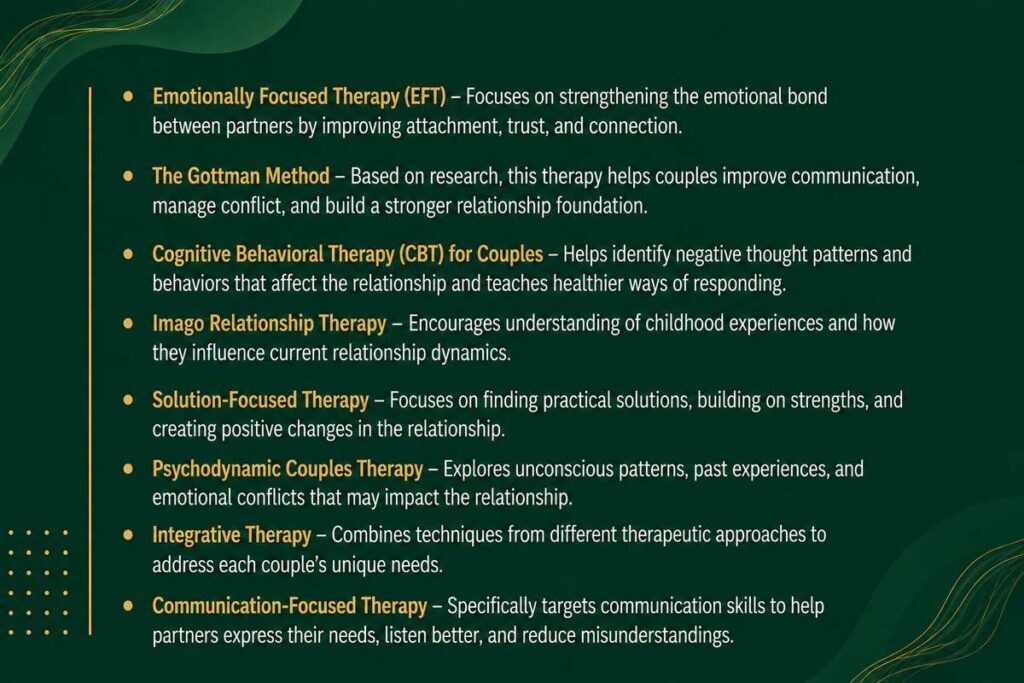
There are several therapeutic approaches that may be used when working with couples. The appropriate approach depends on the relationship and the concerns being addressed.
Emotionally Focused Couples Therapy
This approach focuses on emotional connection, attachment, and recurring relationship patterns. It aims to help partners understand emotional responses and develop stronger bonds.
Cognitive Behavioral Couples Therapy
This approach examines how thoughts and behaviors influence relationship interactions. Partners may learn to recognize unhelpful patterns and develop healthier behaviors.
Integrative Behavioral Couples Therapy
This approach combines behavioral strategies with acceptance and understanding of relationship differences.
Premarital Counseling
Premarital counseling can help engaged couples discuss expectations, communication, finances, family relationships, responsibilities, and other important areas before marriage.
Signs That Couples Therapy May Be Helpful
A couple may consider therapy when relationship difficulties become persistent or difficult to resolve independently.
Possible signs include:
- The same argument happens repeatedly
- Communication has become consistently negative
- One or both partners feel emotionally disconnected
- Trust has been damaged
- Important concerns are being avoided
- Arguments frequently escalate
- Partners feel unheard or misunderstood
- Intimacy has changed significantly
- Major life changes are creating relationship stress
- Attempts to solve problems independently have not worked
Couples do not necessarily need to wait until a relationship reaches a crisis before seeking professional support.
How to Get the Most From Couples Therapy
The effectiveness of therapy can depend partly on how actively partners participate in the process.
Be Honest
Open communication gives the therapist a clearer understanding of the relationship and its challenges.
Listen to Understand
Try to understand your partner’s perspective rather than preparing an immediate response.
Avoid Blame
Using therapy to prove that one partner is “the problem” can make productive communication more difficult.
Practice Between Sessions
Therapy strategies often become more useful when couples apply them in everyday situations.
Be Patient
Relationship patterns usually develop over time. Meaningful changes may also require time and consistent effort.
Focus on Shared Goals
Instead of treating therapy as one partner versus the other, focus on what both people want to improve within the relationship.
Can Couples Therapy Help Without Major Relationship Problems
Yes. Therapy does not have to be limited to relationships experiencing severe conflict.
Some couples use counseling as a preventive or relationship-development tool. They may want to improve communication, understand each other’s needs, or prepare for a major life transition.
Early support may also help couples recognize unhealthy patterns before those patterns become deeply established. The goal can simply be to build a stronger and more resilient relationship.
What Are the Limitations of Couples Therapy
Although there are many potential benefits of couples therapy, it is important to have realistic expectations.
Therapy cannot force a partner to change or guarantee a particular relationship outcome. Both partners may need to participate honestly and consistently for relationship work to be productive.
Progress can also vary depending on:
- The complexity of the relationship concerns
- Willingness to participate
- Communication patterns
- Length of time the problems have existed
- Individual circumstances
- Ability to practice new strategies outside sessions
A qualified mental health professional can help determine whether couples therapy is appropriate for a particular situation.
Tips for Maintaining a Strong Relationship
Couples can also support relationship health through everyday habits.
Helpful practices may include:
- Make time for meaningful conversations
- Express appreciation regularly
- Listen without immediately interrupting
- Discuss concerns before they become major conflicts
- Respect individual boundaries
- Spend quality time together
- Make important decisions collaboratively
- Support each other’s goals
- Avoid using past mistakes as weapons during arguments
- Discuss expectations openly
- Make time for affection and emotional connection
Small, consistent behaviors can have an important role in maintaining relationship satisfaction.
Conclusion
The benefits of couples therapy can extend beyond resolving arguments. Professional relationship counseling can help partners communicate more effectively, understand emotional needs, rebuild trust, manage conflict, improve intimacy, and develop skills for long-term relationship growth.
Couples therapy is not about identifying a winner or assigning blame. It provides an opportunity for partners to examine their relationship patterns and work toward healthier ways of interacting.
Whether a couple is facing ongoing conflict or simply wants to strengthen an existing relationship, professional support can offer useful tools and perspectives. For couples seeking relationship support in Kalamassery understanding these potential benefits can be a helpful first step toward making an informed decision. The American Psychological Association explains that couples therapy focuses on relationship problems affecting partners and can help address concerns such as communication difficulties.