What is Marriage Counselling?
Relationships naturally go through different stages, and couples may sometimes experience disagreements, communication difficulties, emotional distance, or differences in expectations. So, what is marriage counselling? Marriage counselling is a form of professional relationship support that helps couples understand their concerns, communicate more effectively, manage conflicts, and develop healthier ways of interacting. It can be useful for couples at different stages of their relationship, including those who want to address an existing concern or strengthen their relationship before problems become more complicated.
For couples in kochi, marriage counselling can provide a structured and supportive setting where both partners can discuss concerns openly and work toward practical relationship goals.
Unlike the common idea that counselling is only needed when a relationship is in serious trouble, what is marriage counselling can also be understood as a process for improving communication, emotional understanding, cooperation, and relationship satisfaction.

Table of Contents
- What is Marriage Counselling?
- Why Do Couples Seek Marriage Counselling?
- Common Causes of Marriage Problems
- Signs That Marriage Counselling May Help
- Types of Marriage Counselling
- How Marriage Counselling Works
- Benefits of Marriage Counselling
- Techniques Used in Marriage Counselling
- What Happens During a Marriage Counselling Session?
- How Long Does Marriage Counselling Take?
- Tips for Getting the Most From Marriage Counselling
- Common Misconceptions About Marriage Counselling
- When Should Couples Consider Marriage Counselling?
- Frequently Asked Questions
- Conclusion
What is Marriage Counselling?
What is marriage counselling? It is a professional process designed to help married couples understand relationship difficulties and develop healthier ways of communicating and solving problems.
A qualified counsellor provides a neutral environment where both partners can express their thoughts and feelings. The goal is not to decide which partner is right or wrong. Instead, marriage counselling focuses on understanding the relationship as a whole.
A counselling process may explore:
- Communication patterns
- Recurring disagreements
- Emotional needs
- Trust concerns
- Expectations
- Family responsibilities
- Parenting differences
- Financial disagreements
- Emotional connection
- Relationship goals
The exact approach depends on the couple’s concerns, circumstances, and goals.
Why Do Couples Seek Marriage Counselling?
There is no single reason why couples seek professional support. Some couples attend counselling after experiencing a major relationship problem, while others seek guidance when they notice smaller concerns becoming repetitive.
Common reasons include:
- Frequent arguments
- Poor communication
- Difficulty resolving disagreements
- Loss of emotional connection
- Trust concerns
- Different expectations
- Parenting disagreements
- Financial stress
- Family-related pressure
- Major life changes
- Difficulty spending quality time together
- Repeated misunderstandings
Understanding what is marriage counselling also means understanding that couples do not have to wait until a relationship becomes severely strained before seeking support.
Early guidance may help couples identify unhealthy communication patterns and learn better ways to approach disagreements.

Common Causes of Marriage Problems
Marriage difficulties can develop gradually. A single disagreement may not create a major problem, but repeated unresolved concerns can affect emotional connection and relationship satisfaction.
- Communication Breakdown
Communication is one of the most important parts of a healthy relationship. When partners stop expressing themselves clearly or stop listening to each other, misunderstandings can increase.
One partner may feel ignored, while the other may feel criticized or misunderstood.
Marriage counselling can help couples identify these communication patterns and practice healthier ways of expressing concerns.
- Trust Issues
Trust can be affected by dishonesty, secrecy, broken promises, unmet expectations, or previous relationship experiences.
Rebuilding trust generally requires openness, consistency, patience, and communication.
- Financial Conflicts
Money can become a source of tension when partners have different spending habits, financial priorities, or expectations about responsibilities.
A structured conversation can help couples understand their individual perspectives and work toward shared financial goals.
- Parenting Differences
Partners may have different opinions about discipline, education, routines, boundaries, and responsibilities.
These differences can create repeated arguments if they are not discussed constructively.
- Family Pressure
Extended family responsibilities, cultural expectations, household decisions, and boundaries can sometimes create tension between partners.
Open communication can help couples understand each other’s concerns and establish appropriate boundaries.
- Emotional Distance
Some couples remain together while gradually becoming emotionally disconnected.They may communicate about daily responsibilities but rarely discuss feelings, personal concerns, hopes, or relationship needs.
Signs That Marriage Counselling May Help
Recognizing relationship difficulties early can make it easier to address them constructively.
Some common signs include:
- Arguments happen frequently.
- The same disagreement keeps returning.
- Conversations quickly become defensive.
- One or both partners feel unheard.
- Important conversations are avoided.
- Emotional closeness has decreased.
- Trust has become a concern.
- Resentment is building.
- Decisions are difficult to make together.
- Communication feels stressful.
- Partners struggle to understand each other’s perspective.
- Quality time together has reduced.
These signs do not automatically mean that a relationship is failing. They may simply indicate that additional guidance could be useful.
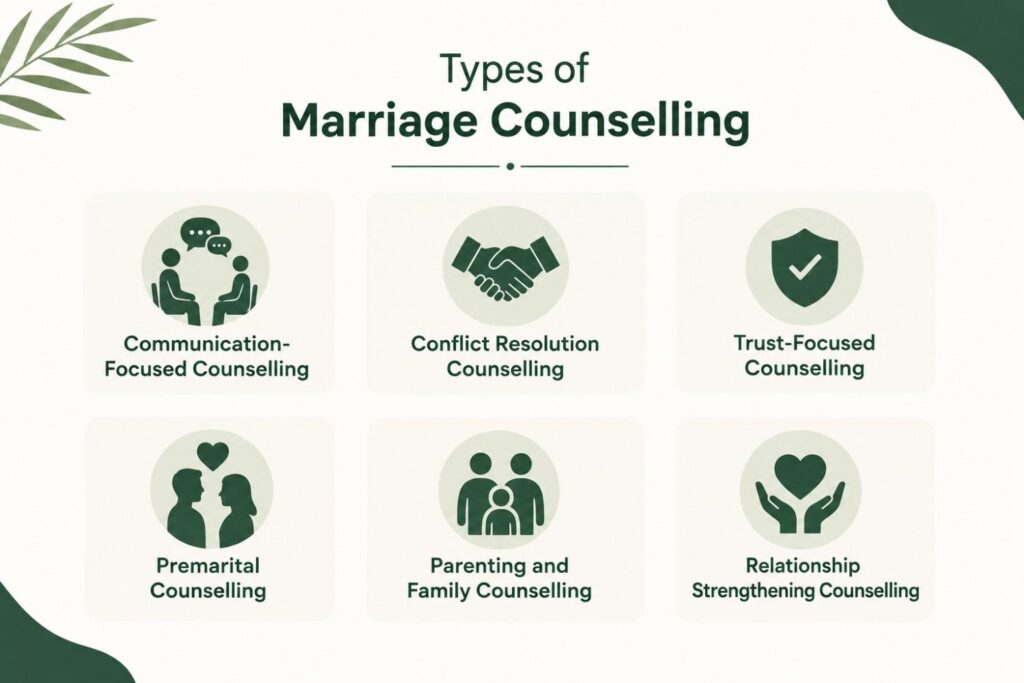
Types of Marriage Counselling
There is no single counselling approach that works identically for every couple. The focus may change depending on the concerns presented during sessions.
- Communication-Focused Counselling
This approach focuses on helping partners express thoughts and feelings more clearly while developing better listening skills.
- Conflict Resolution Counselling
Couples learn ways to approach disagreements without allowing every conflict to become a personal attack.
- Trust-Focused Counselling
This may involve exploring the causes of trust concerns and identifying practical steps for rebuilding openness and reliability.
- Premarital Counselling
Premarital counselling helps couples discuss important areas such as communication, finances, expectations, family planning, responsibilities, and future goals before marriage.
- Parenting and Family Counselling
This type of support can help couples manage differences related to parenting responsibilities and family decisions.
- Relationship Strengthening Counselling
Counselling is not always about repairing a major problem. Some couples seek support to improve communication, emotional connection, and relationship satisfaction.
Benefits of Marriage Counselling
One of the most important parts of understanding what is marriage counselling is recognizing the potential benefits of professional relationship guidance.
- Better Communication
Couples can learn how to express concerns more clearly and listen more effectively.
Better communication may reduce unnecessary misunderstandings.
- Improved Conflict Management
Disagreements are normal in relationships. The goal is not necessarily to eliminate every disagreement but to develop healthier ways of managing differences.
- Greater Emotional Understanding
Counselling can encourage partners to recognize their own emotions and understand the feelings behind their partner’s reactions.
- Stronger Trust
When trust has been affected, structured conversations can help couples understand what happened and explore realistic ways to rebuild confidence.
- Improved Relationship Connection
Couples may learn how to reconnect emotionally and make more space for meaningful conversations.
- Healthier Boundaries
Clear and respectful boundaries can help partners maintain individuality while also supporting the relationship.
- Better Problem-Solving
Marriage counselling can help couples approach challenges as shared problems rather than treating each other as opponents.
- Greater Relationship Awareness
Partners can become more aware of habits, assumptions, communication styles, and emotional triggers that influence their relationship.
Techniques Used in Marriage Counselling
Different counselling professionals may use different evidence-based techniques depending on the couple’s needs.
- Active Listening
Partners practice listening without immediately interrupting, defending themselves, or preparing a counterargument.
- Guided Communication
A counsellor may structure conversations so each partner has an opportunity to speak and respond.
- Emotional Awareness Exercises
Couples may explore emotions behind recurring disagreements.
- Cognitive and Behavioural Techniques
These techniques can help identify unhelpful thoughts and behaviours that contribute to relationship difficulties.
- Conflict Resolution Strategies
Couples may learn practical approaches for discussing disagreements respectfully.
- Goal Setting
Clear relationship goals can make the counselling process more focused and measurable.
How Long Does Marriage Counselling Take?
There is no fixed number of sessions that applies to every couple.
The length of counselling can depend on:
- The concerns being addressed
- How long the problems have existed
- The couple’s goals
- Participation between sessions
- Progress over time
- The counselling approach being used
Some couples may seek short-term support for a specific concern, while others may benefit from longer-term guidance.
The important point is that relationship improvement generally requires participation and consistency from both partners.
Common Misconceptions About Marriage Counselling
- Counselling Is Only for Couples in Crisis
This is one of the most common misconceptions.
Couples can seek counselling to strengthen communication and prevent smaller concerns from becoming larger problems.
- The Counsellor Takes One Partner’s Side
A professional counsellor generally provides a neutral environment and works to understand both perspectives.
- Counselling Gives Instant Solutions
Relationship change usually requires time, practice, and active participation.
- Seeking Counselling Means the Relationship Has Failed
Seeking professional guidance can simply mean that a couple recognizes an area where additional support may be useful.
- Couples Must Agree About Everything
Healthy relationships can include differences in opinions, preferences, and personalities.The goal is not to eliminate every difference but to learn how to manage differences respectfully.
When Should Couples Consider Marriage Counselling?
- Couples may consider counselling when relationship difficulties begin affecting communication, emotional well-being, daily routines, or overall relationship satisfaction.
- It may be particularly useful when the same problems continue despite repeated attempts to resolve them.
- Seeking support earlier can sometimes make it easier to address communication patterns before resentment becomes deeply established.
- However, marriage counselling is not a substitute for emergency or specialized support in situations involving immediate danger, abuse, or serious safety concerns. In such circumstances, appropriate professional and safety resources should be considered.
Conclusion
Understanding what is marriage counselling can help couples make informed decisions when relationship challenges arise. Marriage counselling provides a structured opportunity to explore communication difficulties, trust concerns, emotional distance, recurring conflicts, parenting differences, and other relationship issues.
The process is not about proving who is right or wrong. It is about understanding relationship patterns, improving communication, developing practical problem-solving skills, and creating healthier ways of interacting.
Couples can benefit from approaching counselling with openness, patience, honesty, and a willingness to participate. Professional guidance may also be useful before relationship concerns become more difficult to manage.
For couples seeking relationship support in kochi, understanding what is marriage counselling can be an important first step toward better communication, mutual understanding, and a healthier relationship. To better understand the importance of mental well-being and psychological care, you can explore resources from the World Health Organization’s mental health resource center.
FREQUENTLY ASKED QUESTIONS
What is marriage counselling? It is professional relationship support that helps married couples understand concerns, improve communication, manage conflicts, and develop healthier interaction patterns.
No. Couples may seek counselling for major relationship concerns or for general relationship improvement, communication support, and emotional connection.
Yes. Counselling can teach partners practical communication and listening skills that may help reduce misunderstandings and improve mutual understanding.
It can provide a structured environment for discussing trust concerns and exploring practical steps toward rebuilding openness and confidence.
Professional counselling generally aims to provide a neutral and supportive environment where both partners can express their perspectives.
There is no universal number. The duration depends on the couple's concerns, goals, progress, and counselling approach.
In some circumstances, an individual may seek relationship counselling without their partner. The appropriate format depends on the concern and the professional's approach.
Yes. Counselling can help couples discuss differences in parenting expectations, responsibilities, communication, and decision-making.
It can help couples identify recurring conflict patterns and learn healthier approaches to managing disagreements.
Counselling generally involves privacy and confidentiality, subject to applicable professional and legal requirements. Couples should discuss confidentiality policies with their counsellor.