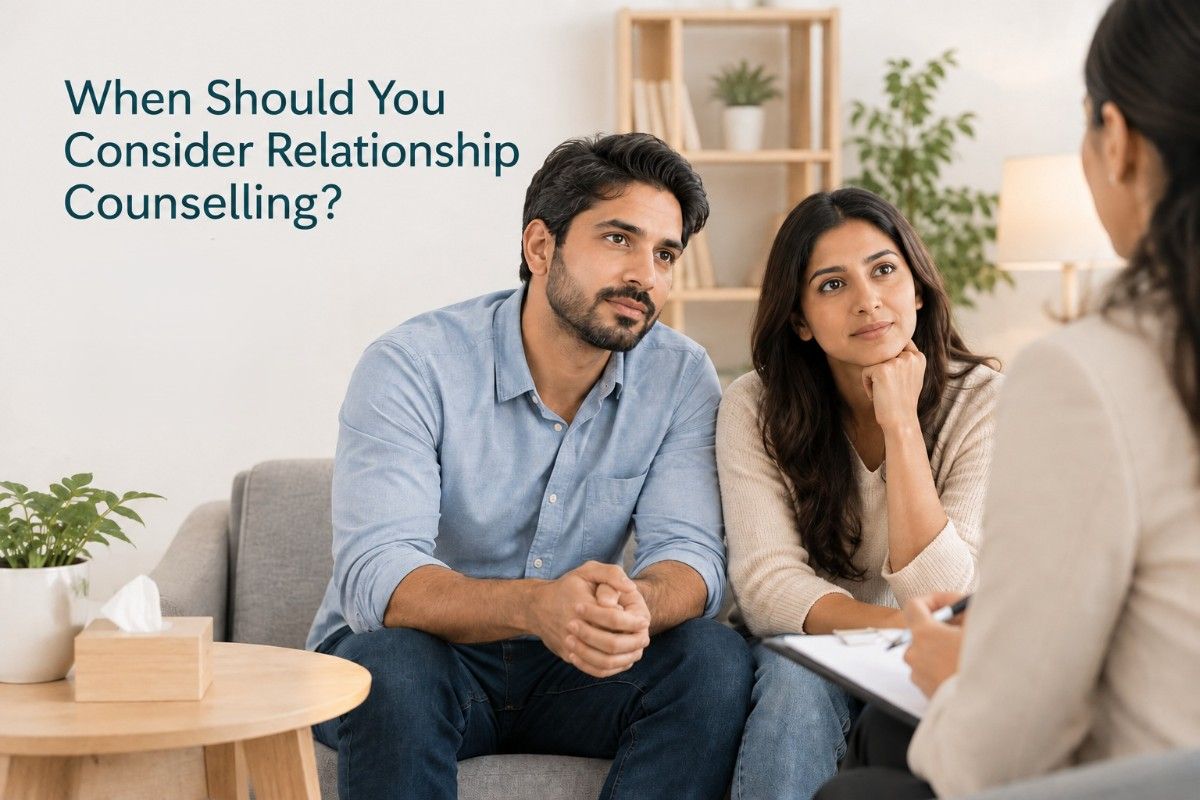
When Should You Consider Relationship Counselling? 7 Key Signs
When should you consider relationship counselling? This is a common question when communication becomes difficult, disagreements keep repeating, or two people begin to feel emotionally disconnected. Every relationship can go through periods of stress, and not every disagreement means counselling is necessary. However, when the same problems continue without resolution or begin affecting everyday life, professional support may be worth considering.
Relationship counselling can provide a structured setting where partners can discuss concerns, understand recurring patterns, and work on communication and conflict-management skills. The American Psychological Association notes that couples therapy addresses problems within and between partners, including difficulties with communication and other relationship concerns.
At Sayana Suzkin’s clinical psychology practice, relationship counselling is one of the areas of care offered alongside individual therapy, family therapy, and premarital counselling. Her official website describes a personalised, evidence-based approach in a safe and confidential setting.
When Should You Consider Relationship Counselling?
You do not have to wait until a relationship reaches a crisis before seeking support. Relationship counselling may be considered when you notice ongoing patterns that you and your partner are finding difficult to change on your own.
Some situations that may indicate it is time to consider professional support include:
- The same arguments happen repeatedly
- Communication has become difficult or unproductive
- Small disagreements regularly become major conflicts
- Trust has been affected
- Emotional distance is increasing
- Important life changes are creating strain
- You are struggling to make decisions together
- You want to improve the relationship before problems become more serious
The American Psychological Association notes that repeated versions of the same unresolved conflict can be a sign that couples may benefit from professional help. It also notes that relationship support does not necessarily have to begin only after a relationship is in serious difficulty
7 Signs You May Consider Relationship Counselling
1. You Keep Having the Same Argument
One of the clearest reasons to consider when should you consider relationship counselling is repeated conflict that never seems to reach a lasting resolution.
You may notice that the topic changes slightly, but the pattern remains the same.
For example:
- The same disagreement comes up every few weeks
- Conversations quickly become defensive
- One person withdraws while the other pushes for an answer
- Arguments end without a clear understanding
- The issue returns even after an apology
Disagreement itself is not necessarily a sign that something is wrong with a relationship. Conflict is a normal part of close relationships. The concern is when a recurring disagreement becomes a cycle that neither person knows how to interrupt.
The APA notes that repeated versions of the same fight, particularly when couples are unable to make progress, can be a reason to seek additional help.
Relationship counselling can provide a structured environment to identify the pattern beneath the argument and explore different ways of communicating.
2. Communication Has Become Difficult
Communication problems are among the common reasons people seek relationship counselling.
You may feel that:
- Your partner does not understand what you are trying to say
- Conversations quickly turn into arguments
- Important topics are avoided
- You feel unheard
- You find yourself repeating the same concern
- You are unsure how to express your needs without creating conflict
Communication is more than simply talking. It involves expressing thoughts clearly, listening, understanding emotions, and finding ways to discuss difficult subjects without escalating every disagreement.
The APA identifies communication as a major issue addressed in couples therapy and highlights communication and listening skills as important parts of effective couples work.
Counselling may help couples slow conversations down, understand communication patterns, and practise more constructive ways of discussing concerns.
3. Trust Has Been Affected
Trust can become difficult to rebuild after repeated misunderstandings, broken agreements, dishonesty, or other relationship disruptions.
You may notice:
- Frequent suspicion
- Difficulty believing what your partner says
- Repeated reassurance-seeking
- Unresolved hurt from a past event
- Constantly revisiting an earlier problem
- Difficulty feeling emotionally secure
Trust concerns can be complicated because the issue is often not only what happened but also what it means to each person now.
Relationship counselling can provide a space for partners to discuss what happened, understand the effects, and explore whether rebuilding trust is possible and what that process might require.
It is important not to assume that counselling will produce one particular outcome. The purpose of therapy is to help people understand their situation and make informed choices about how they want to move forward.
4. You Feel Emotionally Disconnected
Sometimes a relationship can continue functioning on the surface while emotional closeness gradually decreases.
You may notice:
- Less meaningful conversation
- Reduced interest in spending time together
- Feeling alone even when you are together
- Less emotional support
- Difficulty sharing worries or personal experiences
- Increasing emotional distance
Emotional disconnection can develop gradually, particularly during periods of stress, work pressure, parenting responsibilities, illness, or significant life changes.
Counselling may help partners identify what has changed and create space to talk about needs that may not have been communicated clearly.
The goal is not to assign blame. It is to understand the relationship pattern and explore what each person needs from the relationship.
5. A Major Life Change Is Putting Pressure on the Relationship
Relationships can experience additional pressure during major transitions.
These may include:
- Marriage
- Becoming parents
- Parenting changes
- Relocation
- Career changes
- Financial difficulties
- Caring for family members
- Retirement
- Major health concerns
- Changes in family responsibilities
The APA specifically identifies major transitions such as becoming parents as situations that can place predictable stress on couples.
A relationship does not have to be in crisis for counselling to be useful during a transition.
Some couples may seek support because they want to develop better communication and problem-solving habits before the stress becomes overwhelming.
This is also why when should you consider relationship counselling does not always have a negative answer. Counselling can also be considered as a way to navigate change more constructively.
6. You Struggle to Make Important Decisions Together
Partners may disagree about important areas of life without necessarily having a serious relationship problem.
However, repeated difficulty making decisions together can become a source of ongoing stress.
Examples include disagreements about:
- Parenting approaches
- Finances
- Living arrangements
- Career decisions
- Family responsibilities
- Future plans
- Boundaries with relatives
The issue may not simply be the decision itself. It may be the way the couple handles disagreement.
One partner may feel pressured, while the other may feel ignored. One person may avoid decisions, while the other becomes frustrated by the lack of progress.
Counselling can provide a structured setting to understand how decisions are being approached and identify communication patterns that make problem-solving harder.
7. You Want Help Before the Relationship Reaches a Crisis
You do not necessarily need to wait until problems become severe.
Some couples seek counselling because they want to:
- Improve communication
- Understand each other better
- Prepare for marriage
- Manage a major life transition
- Strengthen problem-solving skills
- Discuss recurring concerns
- Create healthier relationship patterns
The APA notes that couples do not have to wait until a relationship is already showing serious trouble before seeking support and that relationship-focused education can include communication, listening, and conflict-management skills.
This makes relationship counselling relevant not only for couples experiencing significant conflict but also for people who want to work on the relationship proactively.
When Should You Consider Relationship Counselling for Communication Problems?
Communication problems can appear in many different forms.
You may find yourselves:
- Interrupting each other
- Raising your voices
- Avoiding difficult conversations
- Repeating the same points
- Assuming what the other person is thinking
- Bringing up old disagreements during new arguments
- Ending conversations without resolving the actual concern
The problem is often not simply the subject being discussed. The interaction pattern itself can become part of the problem.
Communication-focused relationship work may involve learning to express thoughts more clearly, listen without immediately preparing a response, identify emotional triggers, and slow down conversations that usually escalate.
The APA describes collaborative talking and listening skills as central components of effective couples therapy.
When Should You Consider Relationship Counselling After a Loss of Trust?
Trust may become difficult after an event that changes how one partner views the relationship.
The effects may continue even after the original event has ended.
A person may experience:
- Uncertainty
- Repeated questioning
- Emotional withdrawal
- Difficulty believing reassurance
- Fear that the problem may happen again
- Difficulty discussing the issue without conflict
Trust does not usually return simply because someone says that the issue is over.
Rebuilding may involve understanding what each person experienced, identifying what is needed now, and discussing realistic expectations for moving forward.
Relationship counselling can provide a structured space for this process.
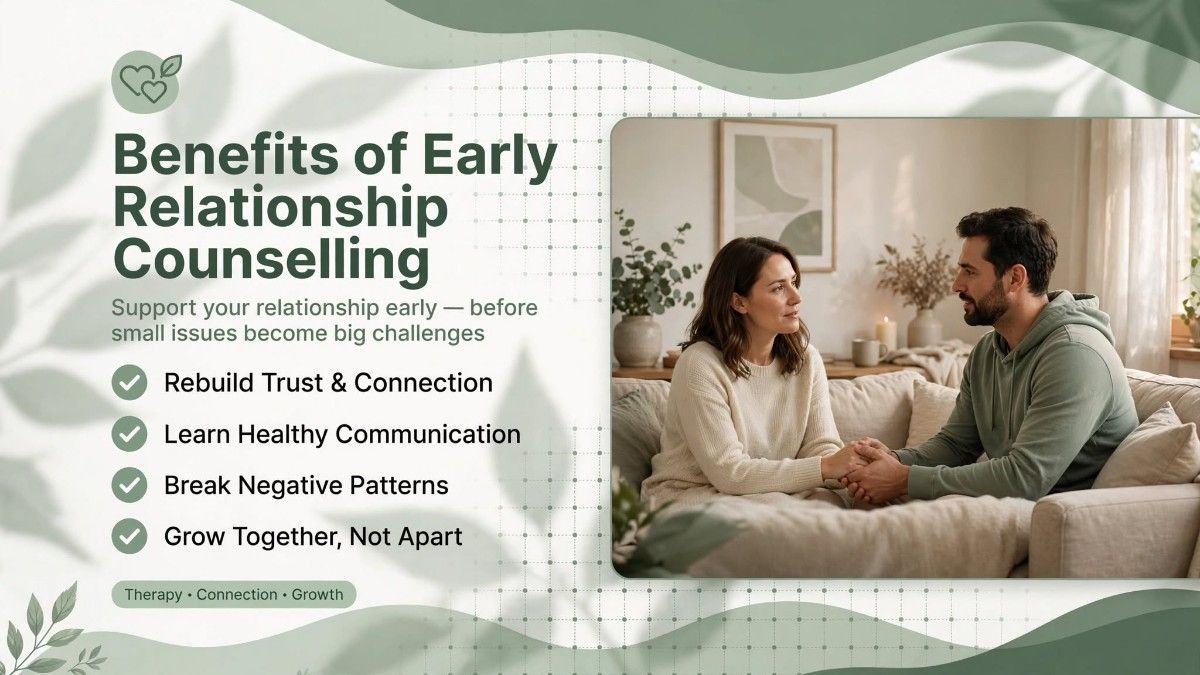
Can Relationship Counselling Help When Only One Partner Wants It?
Ideally, relationship counselling involves the relationship in the room, because both partners bring perspectives that can help explain the problem. The APA notes that couples therapy generally involves both partners, although individual sessions may sometimes be included, particularly at the beginning.
However, there are situations in which one person may want support before the other is ready to attend.
Individual counselling can still provide an opportunity to explore:
- Your own communication patterns
- Emotional reactions
- Relationship expectations
- Boundaries
- Personal concerns
- Ways of approaching difficult conversations
It is important not to treat individual counselling as a substitute for hearing the other person’s perspective when the goal is specifically to work on a shared relationship problem.
Relationship Counselling Before Marriage
Relationship counselling is not only for couples who are already struggling.
Premarital counselling can provide an opportunity to discuss expectations and potential areas of disagreement before marriage.
Possible topics may include:
- Communication styles
- Financial expectations
- Family boundaries
- Parenting expectations
- Lifestyle differences
- Conflict-management approaches
- Future goals
- Roles and responsibilities
Sayana Suzkin’s official profile lists Premarital Counselling alongside relationship and family-focused services.
The purpose is not to predict whether a relationship will succeed. It is to create a space where important subjects can be discussed openly and thoughtfully.
What Happens During Relationship Counselling?
The exact structure can vary depending on the therapist, the concerns being discussed, and whether both partners attend.
A counselling process may include:
Understanding the Main Concern
The therapist may begin by exploring why the couple is seeking support and what each person hopes to understand or change.
Identifying Relationship Patterns
Instead of focusing only on individual incidents, the therapist may look at recurring patterns in communication, conflict, emotional responses, and problem-solving.
Exploring Different Perspectives
Each partner may have a different understanding of the same situation. Making those perspectives clear can help reduce assumptions.
Developing Communication Skills
Therapy may include structured approaches to talking and listening more constructively.
Working Through Specific Problems
Sessions can focus on the concerns most relevant to the couple, such as repeated conflict, parenting stress, trust concerns, or major life transitions.
Reviewing Progress
The couple and therapist can assess what is changing, what remains difficult, and what additional support may be appropriate.
The official Sayana Suzkin website describes her approach as collaborative and personalised, incorporating cognitive-behavioural therapy, mindfulness-based interventions, and psychodynamic understanding.
How Long Does Relationship Counselling Take?
There is no single number of sessions that applies to every couple.
The duration can depend on:
- The number of concerns being addressed
- How long the difficulties have been present
- Whether both partners participate
- The goals of counselling
- The level of ongoing conflict
- Whether individual concerns also need attention
Some couples may seek a limited number of sessions around a specific issue, while others may benefit from longer-term support.
It is better to discuss the expected approach with the psychologist rather than assuming that counselling must follow a fixed number of sessions.
Is Relationship Counselling Only for Couples With Serious Problems?
No.
Relationship counselling can be relevant to couples dealing with significant conflict, but it can also be considered for communication difficulties, life transitions, premarital preparation, family concerns, or a desire to develop healthier relationship skills.
The APA describes couples therapy as addressing problems within and between partners and notes that relationship education and support can also be useful before major difficulties develop.
The important question is not whether your relationship is “bad enough” for counselling.
A more useful question may be whether there is a recurring concern that you and your partner are struggling to address effectively on your own.
When Relationship Counselling May Need a Different Approach
Relationship counselling is not automatically appropriate for every relationship situation.
If there is domestic violence, coercive control, intimidation, threats, or fear, safety needs to come first. The APA notes that conjoint couples treatment is not suitable for all couples experiencing intimate partner violence and that a careful safety assessment is important.
In such circumstances, an individual and private assessment may be more appropriate than beginning joint sessions.
If you feel unsafe with a partner, seek confidential professional support and prioritise your immediate safety. Domestic abuse can involve physical violence as well as threats, intimidation, controlling behaviour, isolation, or financial control.
How to Prepare for Relationship Counselling
You do not need to prepare a perfect explanation before your first appointment.
It may help to think about:
- What brought you to counselling
- What has been happening recently
- How long the concern has been present
- What you have already tried
- What you would like to understand
- What changes you hope to work toward
You may also find it useful to write down two or three specific situations that represent the larger problem.
For example, instead of saying “we always argue,” you could describe one recent disagreement, what happened before it, how each person responded, and how the conversation ended.
Specific examples can make it easier to understand recurring patterns.
Relationship Counselling With Sayana Suzkin
Sayana Suzkin’s official website identifies her as a Clinical Psychologist and lists Relationship Counselling, Couple’s & Family Therapy, and Premarital Counselling among her areas of service. The site also states that she is RCI registered and provides therapy using approaches including cognitive-behavioural, mindfulness-based, and psychodynamic perspectives.
Her practice describes a safe, confidential, and non-judgmental setting in which clients can explore emotional, behavioural, and relationship concerns.
For someone asking when should you consider relationship counselling, the first step does not have to be a major crisis. Repeated unresolved conflict, communication difficulties, changes in emotional connection, trust concerns, or important life transitions can all be reasons to explore whether professional support may be useful.
A relationship counselling session can provide space to slow down the conversation, understand the concerns from both perspectives, and identify practical areas to work on.
Frequently Asked Questions
When should you consider relationship counselling?
You may consider relationship counselling when recurring conflicts, communication problems, trust concerns, emotional distance, major life changes, or decision-making difficulties are becoming hard to manage together.
Is relationship counselling only for couples who are struggling?
No. Some couples seek counselling to strengthen communication, prepare for marriage, manage transitions, or address concerns before they become more difficult.
Can counselling help with repeated arguments?
It can provide a structured setting to identify recurring conflict patterns and practise more constructive communication and problem-solving approaches.
Can one partner attend relationship counselling alone?
Individual counselling can help one person explore their own feelings, expectations, communication patterns, and boundaries. However, relationship-focused work can benefit from hearing both partners’ perspectives when both are able and willing to participate.
What issues can relationship counselling address?
Depending on the therapist and the situation, relationship counselling may address communication difficulties, recurring conflict, trust concerns, family issues, parenting stress, major life transitions, and premarital concerns. Sayana Suzkin’s official website specifically lists relationship, couple’s and family, and premarital counselling.
Does relationship counselling mean the relationship is failing?
No. Seeking counselling does not by itself indicate that a relationship is failing. It can simply mean that the people involved want professional help understanding a recurring concern or developing better relationship skills.
Can relationship counselling help before marriage?
Yes. Premarital counselling can provide a structured opportunity to discuss expectations, communication, family boundaries, responsibilities, and future plans before marriage.
What happens in the first relationship counselling session?
The first session may focus on understanding the main concerns, relationship history, each person’s perspective, and the goals for counselling. The exact structure varies between psychologists and situations.
How long does relationship counselling take?
There is no fixed duration. It depends on the concerns being addressed, the goals of therapy, participation, and how the situation develops over time.
What if my partner refuses counselling?
You can still seek individual psychological support to understand your own concerns, communication patterns, boundaries, and options. Whether joint counselling is appropriate depends on the circumstances.