How Many Sessions are Needed for Marriage Counselling: 7 Key
How Many Sessions are Needed for Marriage Counselling? This is one of the most common questions couples ask before beginning professional relationship support. The answer is different for every couple because counselling is based on the concerns, communication patterns, emotional needs, and goals of the relationship. Couples seeking marriage counselling in Thrissur may need only a few sessions for a specific concern, while others may benefit from longer-term support.
Marriage counselling is not a fixed programme with the same number of appointments for everyone. Some couples attend counselling to improve communication, while others seek help with trust issues, recurring disagreements, emotional distance, or major relationship changes. The number of sessions depends largely on what the couple wants to work on and how consistently both partners participate.
Understanding what influences counselling duration can help couples approach the process with realistic expectations.
How Many Sessions are Needed for Marriage Counselling
There is no universal number of sessions that applies to every couple. Some couples may notice useful changes after a few sessions, while others may require several weeks or months of structured counselling.
For relatively straightforward concerns, counselling may involve a short series of appointments. More complicated relationship difficulties can require additional sessions so that underlying patterns can be understood and addressed.
The number of sessions may depend on:
- The main reason for seeking counselling
- How long the relationship problem has existed
- The severity of ongoing conflict
- Both partners’ willingness to participate
- Communication patterns between partners
- Emotional or trust-related difficulties
- The goals established during counselling
- Progress between appointments
- Whether additional individual support is needed
The purpose is not simply to complete a certain number of sessions. Instead, counselling aims to help couples develop practical skills and healthier ways of handling relationship challenges.
What Determines the Number of Marriage Counselling Sessions
Several factors can influence how long counselling takes. A professional counsellor may initially assess the couple’s concerns and identify areas that need attention.
The Complexity of the Problem
A single communication issue may require less time than multiple long-standing relationship concerns. When several problems are connected, counselling may need to address them gradually.
The Duration of the Conflict
Problems that have existed for years may take longer to change because couples can develop deeply established patterns of communication and behaviour.
The Goals of Counselling
Some couples may want help resolving one particular disagreement. Others may want to rebuild emotional connection, improve communication, or develop healthier conflict-resolution skills.
Participation from Both Partners
Progress can be easier when both partners attend sessions, communicate openly, and practise recommended strategies outside appointments.
Progress Between Sessions
Counselling does not happen only inside the consultation room. Couples may be given communication exercises, reflection activities, or practical strategies to use at home.
Common Reasons Couples Seek Marriage Counselling
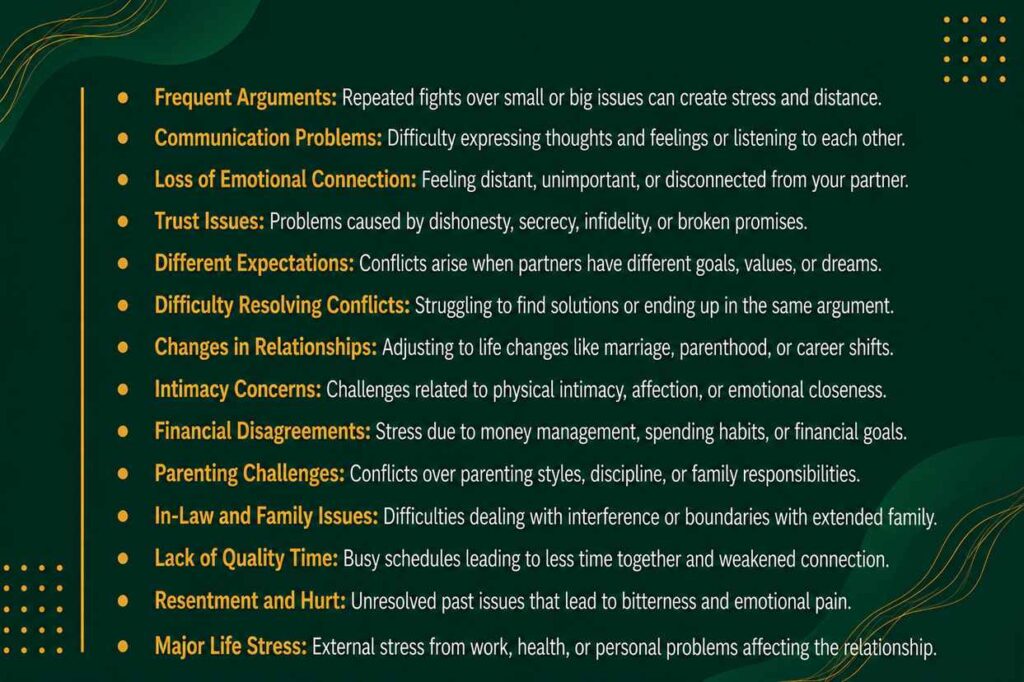
Marriage counselling can be useful for a wide range of relationship concerns. Couples do not necessarily have to wait until a relationship reaches a crisis before seeking professional guidance.
Common reasons include:
- Frequent arguments
- Communication difficulties
- Emotional distance
- Loss of trust
- Repeated misunderstandings
- Differences in expectations
- Difficulty resolving disagreements
- Changes in family responsibilities
- Problems adjusting to major life changes
- Concerns about intimacy
- Financial disagreements
- Parenting-related conflicts
- Feeling disconnected from a partner
The number of counselling sessions may vary depending on whether the concern is recent or has become a long-standing pattern.
How Many Sessions are Needed for Marriage Counselling for Communication Problems
Communication difficulties are among the common reasons couples consider counselling. Some couples may understand what they want to say but struggle to express it without criticism, defensiveness, anger, or withdrawal.
In these situations, counselling may focus on identifying unhealthy communication patterns and developing better ways to talk about difficult subjects.
Sessions may address skills such as:
- Listening without immediately responding defensively
- Expressing feelings clearly
- Discussing concerns without personal attacks
- Identifying repeated arguments
- Understanding a partner’s perspective
- Setting boundaries respectfully
- Learning healthier conflict-resolution techniques
The number of sessions depends on how deeply communication problems have affected the relationship and how willing both partners are to practise new approaches.
How Many Sessions are Needed for Marriage Counselling When Trust Is Damaged
Trust-related concerns can sometimes require more time because rebuilding confidence in a relationship is usually a gradual process.
When trust has been affected, counselling may explore the events that caused the problem, emotional reactions, communication difficulties, expectations, and steps needed to rebuild reliability.
Progress may involve:
- Understanding what damaged trust.
- Allowing both partners to communicate their concerns.
- Establishing realistic expectations.
- Improving transparency where appropriate.
- Developing healthier communication habits.
- Rebuilding consistency over time.
There is no guaranteed number of appointments for rebuilding trust. The counselling process may continue according to the couple’s progress and goals.
Types of Marriage Counselling and Their Possible Duration
Different counselling approaches may be used depending on the couple’s needs. The duration can vary even when two couples receive support for similar concerns.
Couples Counselling
Couples counselling focuses on relationship concerns involving both partners. Sessions may address communication, conflict, emotional connection, expectations, and relationship patterns.
Premarital Counselling
Premarital counselling is generally focused on preparing couples for marriage. Topics may include communication, finances, family expectations, responsibilities, conflict management, and future goals.
Relationship Counselling
Relationship counselling may help couples understand recurring difficulties and develop practical strategies for improving the relationship.
Individual Counselling Alongside Couples Counselling
In some situations, one or both partners may benefit from individual support in addition to couples counselling. Whether this is appropriate depends on the circumstances and professional assessment.
What Happens During the First Marriage Counselling Session
The first appointment often focuses on understanding the couple’s concerns and establishing counselling goals.
A counsellor may ask about:
- The main reason for seeking counselling
- How long the concern has existed
- Major relationship changes
- Communication patterns
- Previous attempts to solve the problem
- Individual expectations from counselling
- Areas where the relationship currently feels difficult
The first session may also help determine whether couples counselling is appropriate and what areas should be prioritised.
It is normal for couples not to solve their main problem during the first appointment. Initial sessions are often used to understand the relationship dynamics and establish a practical direction for future work.
Signs That More Marriage Counselling Sessions May Be Helpful
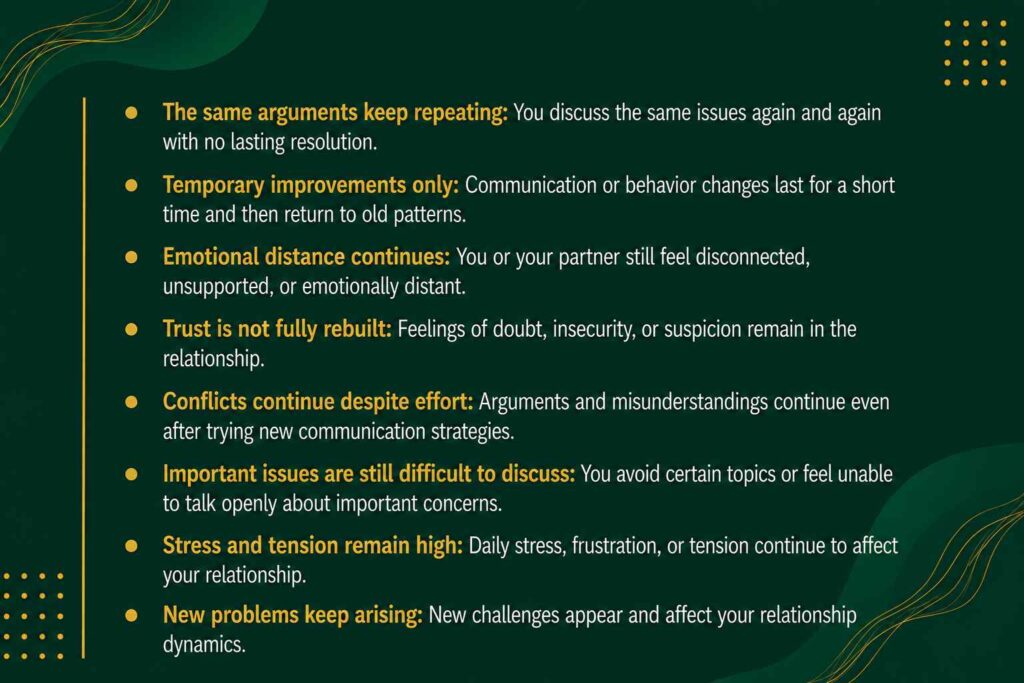
Some couples may feel better after a few appointments, while others may need additional support. Continuing counselling may be considered when significant concerns remain unresolved.
Possible signs include:
- The same argument continues repeatedly.
- Communication improvements are temporary.
- One or both partners still feel emotionally disconnected.
- Trust has not been sufficiently rebuilt.
- Conflicts continue despite practising new strategies.
- Important relationship concerns remain difficult to discuss.
- The couple wants support maintaining improvements.
- New concerns appear during the counselling process.
Needing more sessions does not necessarily mean counselling is unsuccessful. Relationship patterns can take time to change, particularly when problems have existed for a long period.
Benefits of Attending Marriage Counselling
Marriage counselling can provide couples with a structured environment to discuss difficult subjects. Instead of repeatedly having the same argument, couples can learn to identify the pattern behind the disagreement.
Potential benefits include:
- Better communication
- Improved listening skills
- Greater awareness of relationship patterns
- Healthier conflict management
- Better understanding of each partner’s needs
- Improved emotional connection
- More constructive discussions
- Practical relationship strategies
- Greater clarity about relationship goals
The benefits depend on the concerns being addressed, the counselling approach, and the couple’s participation.
How to Make Marriage Counselling Sessions More Effective
The effectiveness of counselling can depend partly on what couples do between appointments. Regular participation and active engagement may help couples make better use of their sessions.
Be Honest During Sessions
Open communication gives the counsellor a clearer understanding of the relationship. Avoiding important concerns may make it harder to identify the underlying problem.
Listen to Understand
Both partners should have opportunities to explain their experiences. Listening does not necessarily mean agreeing with everything the other person says.
Practise Strategies at Home
If counselling introduces communication or conflict-resolution techniques, practising them outside sessions can help turn them into regular habits.
Avoid Expecting Instant Results
Relationship patterns usually develop over time. Meaningful improvement may require repeated effort rather than a single conversation.
Set Realistic Goals
Clear goals can make counselling more focused. Couples may decide whether they want to improve communication, reduce conflict, rebuild connection, or address a particular relationship concern.
When Should Couples Consider Marriage Counselling
There is no requirement to wait until relationship problems become severe. Couples may consider counselling when they notice recurring difficulties that they cannot resolve effectively on their own.
Early support may be useful when:
- Arguments are becoming more frequent.
- Communication feels increasingly difficult.
- Partners feel misunderstood.
- Emotional connection has reduced.
- Important issues are repeatedly avoided.
- Small disagreements regularly become major conflicts.
- Both partners want to improve the relationship.
Seeking counselling does not mean a relationship has failed. For many couples, it can simply be a structured way to understand relationship difficulties and learn healthier approaches.
What Can Couples Expect After Several Sessions
Progress can look different for different couples. Counselling is not necessarily about eliminating every disagreement. Healthy relationships can still involve differences of opinion.
Instead, progress may involve handling disagreements differently.
A couple may begin to notice:
- Fewer repetitive arguments
- More productive conversations
- Better emotional awareness
- Improved listening
- Greater understanding of each other’s concerns
- More effective problem-solving
- Reduced defensiveness
- Increased confidence in managing disagreements
The goal is often to build skills that couples can continue using after counselling sessions end.
Can Marriage Counselling Be Short-Term
Yes. Some relationship concerns may be suitable for short-term counselling, particularly when the problem is specific and both partners are motivated to work on it.
Short-term counselling may focus on a clearly defined concern, such as communication difficulties or a recurring disagreement. The exact duration depends on the assessment and progress.
However, short-term counselling should not be viewed as a fixed number of sessions that guarantees a particular outcome. The counselling plan can change according to the couple’s needs.
Can Marriage Counselling Take Several Months
es. Some couples may require longer-term counselling when relationship concerns are complicated, longstanding, or involve several connected issues.
Longer counselling may provide more time to:
- Understand established relationship patterns
- Address multiple concerns
- Practise new communication skills
- Work through emotional difficulties
- Monitor progress
- Strengthen positive changes
- Address setbacks when they occur
The duration should be based on therapeutic needs rather than an arbitrary deadline.
Tips for Deciding How Many Sessions to Attend
Couples do not necessarily need to decide the entire counselling schedule before beginning. A professional can help assess the situation and discuss an appropriate approach.
Useful questions to consider include:
- What problem do we want to address?
- How long has this problem existed?
- What changes would we like to see?
- Are both partners willing to participate?
- Are improvements continuing between sessions?
- Are there unresolved concerns that need more attention?
These questions can help couples approach counselling with practical expectations rather than focusing only on the number of appointments.
Conclusion
The answer to How Many Sessions are Needed for Marriage Counselling? depends on the couple rather than a universal schedule. A few sessions may be sufficient for some specific concerns, while more complicated relationship problems may require continued support.
The most important factors include the nature of the relationship concern, how long it has existed, the goals of counselling, participation from both partners, and progress over time.
Marriage counselling should therefore be viewed as a process rather than a predetermined number of appointments. Couples can begin by identifying their main concerns, discussing their goals, and working with a qualified professional to determine an appropriate counselling approach.
With consistent participation, realistic expectations, and a willingness to practise healthier communication, counselling can help couples develop practical skills for managing relationship challenges more constructively. For couples considering professional support in Thrissur, understanding the expected counselling process can make the decision easier and more informed. For additional information on relationship and mental health support, the American Psychological Association provides evidence-based resources on healthy relationships and communication.