7 Powerful Signs: When Should You Start Marriage Counselling
Marriage can go through periods of disagreement, emotional distance, stress, and uncertainty. Knowing when should you start marriage counselling can help couples address concerns before they become deeply rooted. In Kalamassery, as in any community, couples may experience relationship challenges related to communication, finances, family responsibilities, work pressure, parenting, or emotional needs. Marriage counselling provides a structured and supportive environment where couples can understand their concerns and work toward healthier communication.
Seeking counselling does not necessarily mean that a marriage is failing. It can simply mean that both partners want to understand each other better and strengthen their relationship. Early support can often make it easier to identify unhealthy patterns and develop practical ways to manage disagreements.
What Is Marriage Counselling
Marriage counselling is a form of relationship counselling designed to help married couples address difficulties within their relationship. A trained mental health professional or marriage counsellor facilitates conversations between partners and helps them understand recurring relationship patterns.
The goal is not to decide who is right or wrong. Instead, counselling focuses on helping couples:
- Communicate more effectively
- Understand each other’s perspectives
- Resolve recurring conflicts
- Rebuild emotional connection
- Develop healthier ways to handle disagreements
- Address trust-related concerns
- Strengthen their relationship
- Make informed decisions about their future together
Marriage counselling may be useful for couples experiencing a specific problem as well as those who simply want to improve their relationship.
When Should You Start Marriage Counselling
Understanding when should you start marriage counselling can be difficult because every relationship has occasional disagreements. Arguments alone do not necessarily mean professional help is required.
However, counselling may be worth considering when relationship problems become frequent, intense, or difficult to resolve independently.
Some important signs include persistent communication problems, repeated arguments, emotional withdrawal, loss of trust, and difficulty discussing important issues without conflict.
The earlier couples recognize these patterns, the more opportunities they may have to address them constructively.
Communication Has Become Consistently Difficult
Communication is one of the most important parts of a healthy marriage. When conversations repeatedly turn into arguments, criticism, silence, or defensiveness, the relationship can become emotionally exhausting.
You may consider marriage counselling if:
- Small conversations frequently become major arguments
- One or both partners avoid important discussions
- You feel unheard or misunderstood
- Conversations end without resolving the original issue
- You are afraid to express certain feelings
- You frequently communicate through anger or silence
Counselling can help couples identify communication patterns and learn healthier ways to express needs, concerns, expectations, and emotions.
The Same Arguments Keep Happening
Occasional disagreements are normal. However, repeatedly having the same argument without reaching a meaningful resolution can indicate an underlying relationship problem.
For example, couples may repeatedly argue about:
- Household responsibilities
- Money
- Parenting
- Family boundaries
- Time spent together
- Work-related stress
- Emotional attention
- Intimacy
- Social activities
If the topic changes but the argument follows the same pattern, the underlying issue may involve unmet emotional needs, communication difficulties, resentment, or unresolved hurt.
Marriage counselling can help identify the pattern behind recurring conflicts instead of focusing only on the latest disagreement.
Emotional Distance Is Increasing
A couple can live together while gradually becoming emotionally disconnected. Partners may stop sharing their thoughts, experiences, concerns, and plans with each other.
Signs of emotional distance can include:
- Spending less meaningful time together
- Little interest in each other’s daily experiences
- Reduced affection
- Feeling lonely despite being married
- Avoiding personal conversations
- Feeling more comfortable talking to other people than your partner
If emotional distance continues for a long period, it may affect relationship satisfaction.
This is an important reason to consider when should you start marriage counselling rather than waiting until emotional disconnection becomes more difficult to address.
Trust Has Been Damaged
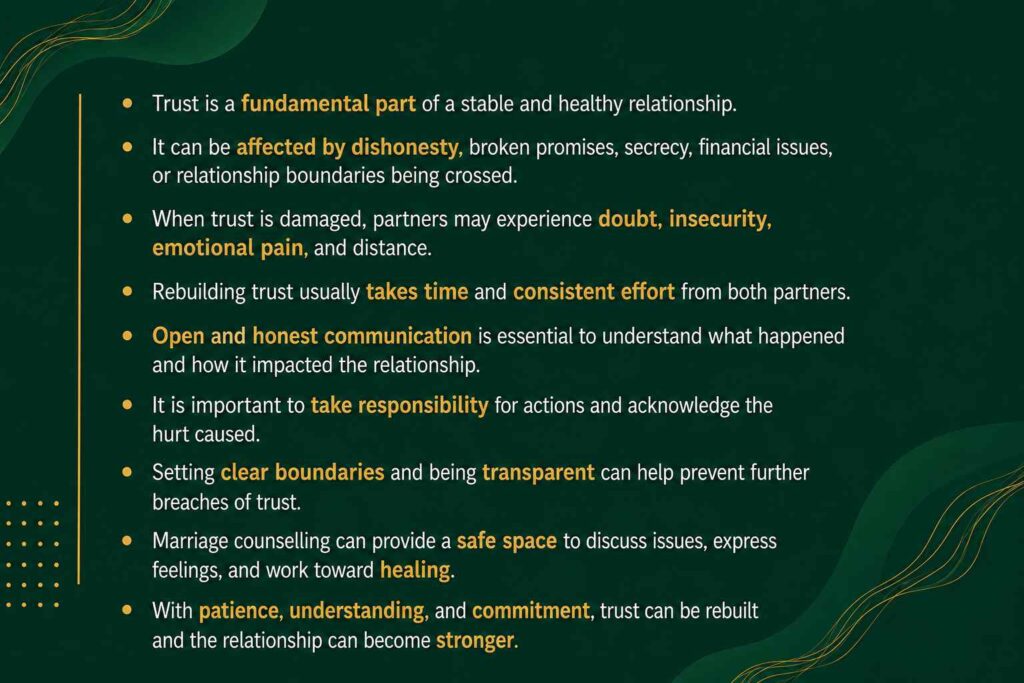
Trust is a fundamental part of a stable relationship. It can be affected by dishonesty, broken promises, secrecy, financial issues, or relationship boundaries being crossed.
Rebuilding trust usually takes time. Simply telling someone to “move on” may not resolve the emotional impact of what happened.
Marriage counselling may help couples:
- Discuss what caused the loss of trust
- Express feelings safely
- Understand the impact of the situation
- Establish clearer boundaries
- Improve transparency
- Develop realistic expectations
- Work toward rebuilding emotional security
Trust recovery is often a gradual process, and professional guidance can help couples navigate difficult conversations.
You Feel Resentment Toward Your Partner
Unresolved disappointment can gradually turn into resentment. A partner may continue thinking about past arguments or situations that were never properly addressed.
Common signs of resentment include:
- Frequently bringing up past mistakes
- Feeling irritated by small things
- Keeping score of who does more
- Feeling unappreciated
- Withholding affection
- Assuming negative intentions
- Finding it difficult to forgive
If resentment is becoming a regular part of the relationship, counselling may provide an opportunity to discuss the underlying issues and work toward resolution.
Major Life Changes Are Creating Relationship Stress
Significant changes can place pressure on even strong marriages. Couples may struggle when their responsibilities, priorities, or expectations change.
Examples include:
- Getting married after a long-distance relationship
- Having a child
- Parenting challenges
- Career changes
- Job loss
- Relocation
- Financial difficulties
- Caring for ageing family members
- Changes in lifestyle
- Major health-related challenges
The issue may not necessarily be the life event itself. Instead, the stress associated with adapting to the change can affect communication and emotional connection.
Counselling can help couples adjust to new responsibilities and establish healthier ways to support each other.
You Are Considering Separation
When one or both partners are seriously considering separation, professional support may help clarify what is happening in the relationship.
Counselling does not automatically mean that a couple must remain together. Depending on the situation and the type of counselling, it can help partners understand their concerns, communicate more constructively, and consider their options carefully.
If separation is being discussed frequently, seeking professional support earlier may help prevent conversations from becoming increasingly hostile.
Common Causes of Marriage Problems
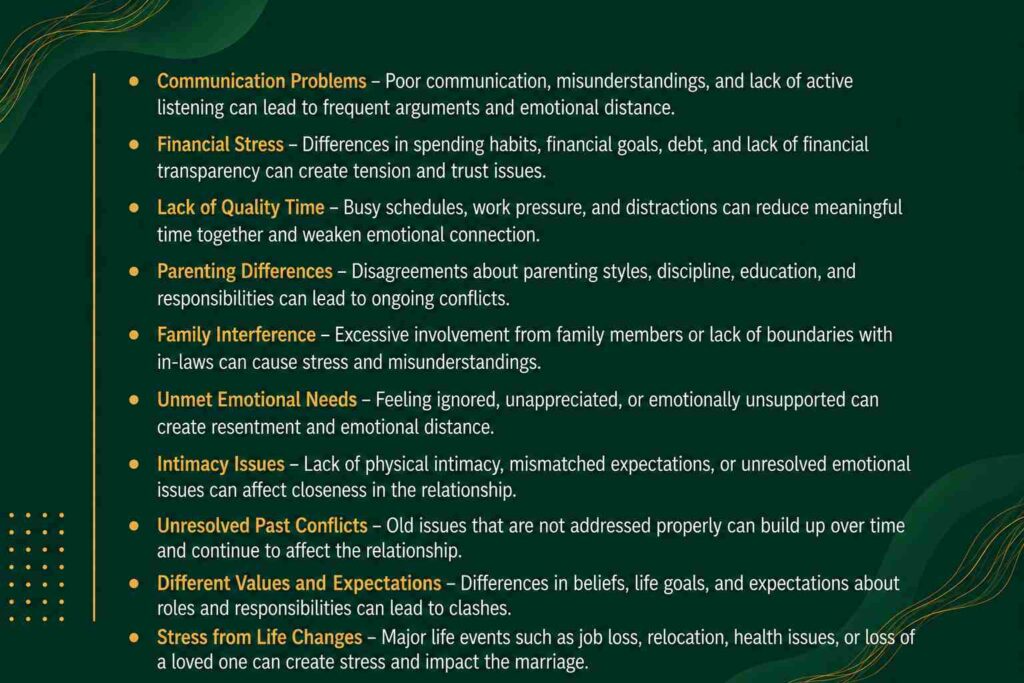
Relationship difficulties can develop for many reasons. Often, there is more than one contributing factor.
Communication Problems
Poor communication may cause partners to misunderstand each other’s intentions, needs, or expectations.
Financial Stress
Differences in spending habits, debt, savings goals, or financial responsibilities can create repeated disagreements.
Lack of Quality Time
Busy schedules can gradually reduce meaningful interaction between partners.
Parenting Differences
Partners may have different ideas about discipline, education, routines, or responsibilities.
Family Boundaries
Extended family expectations can sometimes create tension when couples have different views about boundaries and responsibilities.
Emotional Needs
A relationship can become strained when one or both partners feel emotionally neglected or unsupported.
Unresolved Past Conflicts
Problems that are repeatedly avoided may continue affecting the relationship even when they are not openly discussed.
Types of Marriage Counselling
Marriage counselling can take different approaches depending on the couple’s needs and the professional’s therapeutic framework.
Couples Counselling
This generally focuses on relationship concerns involving both partners, such as communication, conflict resolution, emotional connection, and trust.
Relationship Counselling
Relationship counselling may address broader interpersonal patterns and help partners understand how they interact with each other.
Premarital Counselling
Premarital counselling is intended for couples preparing for marriage. It can help them discuss expectations, communication, finances, family relationships, responsibilities, and future goals.
Individual Counselling During Relationship Difficulties
Sometimes one partner may benefit from individual counselling alongside relationship-focused support, particularly when personal emotional concerns are affecting the relationship.
The appropriate approach depends on the circumstances and the goals of the people involved.
Benefits of Starting Marriage Counselling Early
One of the most important considerations when asking when should you start marriage counselling is whether you need to wait until a problem becomes severe.
In many cases, couples can benefit from seeking support when they first notice persistent difficulties.
Potential benefits include:
- Better communication
- Improved listening skills
- Greater emotional understanding
- Healthier conflict management
- Increased awareness of relationship patterns
- Better understanding of each partner’s needs
- Opportunities to rebuild trust
- Reduced resentment
- Improved emotional connection
- More constructive decision-making
Counselling cannot guarantee a particular outcome, but it can provide a structured setting for addressing relationship concerns.
What Happens During Marriage Counselling
The exact process varies depending on the counsellor and the couple’s needs. Generally, the first sessions involve understanding the relationship history, current concerns, and goals.
A counsellor may explore:
- What brought the couple to counselling
- How conflicts usually begin
- How each partner responds during disagreements
- Communication patterns
- Emotional needs
- Relationship expectations
- Previous attempts to solve the problem
- Goals for counselling
Later sessions may focus on developing communication and conflict-resolution strategies.
Couples may also be encouraged to practise new approaches between sessions.
How to Prepare for Marriage Counselling
Preparing for counselling can make the process more productive.
Identify Your Main Concerns
Think about the problems that are affecting your relationship most significantly.
Be Honest
Open communication is important during counselling. Hiding important information may make it harder to understand the relationship dynamics.
Avoid Treating Counselling as a Competition
The purpose is not to prove that one partner is completely right and the other is completely wrong.
Listen to Your Partner
Try to understand what your partner is communicating rather than preparing a response while they are speaking.
Set Realistic Expectations
Relationship improvement usually takes time. A single session may not resolve long-standing problems.
Tips for Choosing Marriage Counselling
When looking for professional support, consider factors such as:
- Relevant qualifications and professional training
- Experience with couples and relationship concerns
- Counselling approach
- Availability and session format
- Whether both partners feel comfortable
- Confidentiality practices
- Clear communication about fees and appointments
It is also important to understand that the quality of the therapeutic relationship matters. Both partners should ideally feel that the counselling environment allows them to communicate honestly and respectfully.
When Marriage Counselling May Not Be Enough
Marriage counselling is not appropriate as the only intervention in every situation.
If a relationship involves violence, coercive control, threats, or serious safety concerns, safety should take priority. In such circumstances, specialized professional support may be more appropriate than ordinary couples counselling.
Similarly, serious mental health, substance-related, or other individual concerns may require separate professional assessment and treatment.
The appropriate form of support depends on the specific circumstances.
Can Marriage Counselling Prevent Divorce
Marriage counselling cannot guarantee that a couple will stay together. Its purpose is to help partners understand their relationship, address problems, improve communication, and make informed decisions.
Some couples may use counselling to strengthen their marriage. Others may use it to understand whether their relationship can be repaired. The outcome depends on the circumstances, willingness of both partners to participate, and the nature of the relationship difficulties.
Seeking counselling should therefore be viewed as an opportunity for professional guidance rather than a guarantee of a particular result.
How Long Does Marriage Counselling Take
There is no fixed number of sessions that applies to every couple.
Some couples may focus on a specific concern over a relatively short period, while others may need longer-term support for complex or long-standing relationship problems.
The duration may depend on:
- Severity of relationship difficulties
- Length of time the problem has existed
- Willingness to participate
- Counselling goals
- Progress between sessions
- Complexity of underlying concerns
Regularly reviewing progress with the counsellor can help determine whether continued counselling is useful.
When Should You Start Marriage Counselling Before Problems Get Worse
A useful principle is not to wait until communication has completely broken down.
You may want to consider counselling when you notice that relationship problems are becoming repetitive, emotionally intense, or difficult to resolve independently.
Early intervention may be particularly useful when both partners still want to improve the relationship but are unsure how to move forward.
Understanding when should you start marriage counselling can therefore involve paying attention to patterns rather than waiting for a single major crisis.
Conclusion
Knowing when should you start marriage counselling can help couples take action before relationship difficulties become overwhelming. Persistent communication problems, repeated arguments, emotional distance, damaged trust, resentment, major life changes, and discussions about separation are all situations where professional support may be worth considering.
Marriage counselling is not about assigning blame. It provides couples with an opportunity to understand their relationship patterns, communicate more effectively, address unresolved concerns, and make thoughtful decisions about their future.
If relationship problems are affecting everyday life and repeated attempts to resolve them are not working, seeking appropriate professional support can be a constructive step. Couples in Kalamassery can also consider qualified relationship counselling services when they feel that additional guidance would help them move forward. The American Psychological Association explains that couples therapy can help partners address relationship problems and communication difficulties through professional support. American Psychological Association – Couples Therapy